


Lec4: Threads(多线程编程)
为什么需要线程、多线程模型、Pthreads/Java/OpenMP 等线程库,以及隐式线程与线程相关问题。
课程导航与课程讲次
课程讲次
文章目录
Threads(多线程编程)
引入:为什么需要线程
首先来看几段代码:
代码1:
main(){ while(1){ RetrieveData(); // Block for 1 second DisplayData(); // Block for 1 second GetInputEvents(); // Block for 1 second }}代码2:
main(){ while(1){ RetrieveALittleData(); // Block for 0.1 second DisplayALittleData(); // Block for 0.1 second GetAFewInputEvents(); // Block for 0.1 second }}
代码3:main(){ while(1){ if(CheckData()==True){ RetrieveALittleData(); // 0.1 second DisplayALittleData(); // 0.1 second } if(CheckInputEvents()==True){ GetAFewInputEvents(); // 0.1 second } }}- 对于代码1来说,如果想要操作系统有一个更快的反应(more responsive),就需要将各个进程切换的时间减少。于是我们得到了代码2
- 在代码2的基础上,我们可以增加条件判断,比如在需要查看数据的情况下在选择查找数据,这样可以减少无效时间。这样就的得到了代码3
- 然而,切换的时间消耗也是比较大的。较少的 response time 会导致切换的时间大大增多。
- More precisely, we want to SCHEDULE these operations in our own program code.
- Leave the tedious work to the OS which schedules them in Threads!
概述
什么是线程
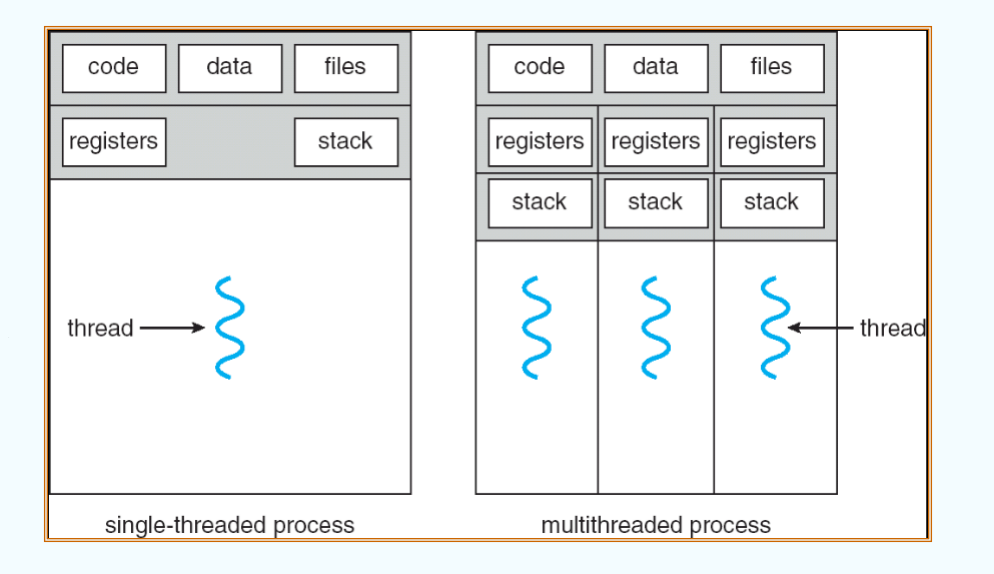
- 线程是 CPU 使用的基本单元,包括:
- 线程 ID
- 程序计数器
- 寄存器组
- 堆栈
- 线程与同一进程的其他线程共享:
- 代码段
- 数据段
- 其他系统资源
据此,我们可以将进程分为两种:单线程进程与多线程进程
使用多线程编程有以下好处:
- Responsiveness
- interactive applications
- 即使部分阻塞或者是执行冗长操作,都可以继续执行。
- Resource Sharing
- memory for code and data can be shared.
- 线程默认共享它们所属进程的内存和资源。
- 代码和数据共享的优点是:允许一个应用程序在同一地址空间内有多个不同活动线程。
- Economy
- creating processes are more expensive.
- 创建一个进程的代价很大,因此显得线程创建的代价很小
- Utilization of MP Architectures(可伸缩性)
- multi-threading increases concurrency.
- 多线程进程可以运行在多处理核上,单线程进程只能运行在一个 CPU 上。
-
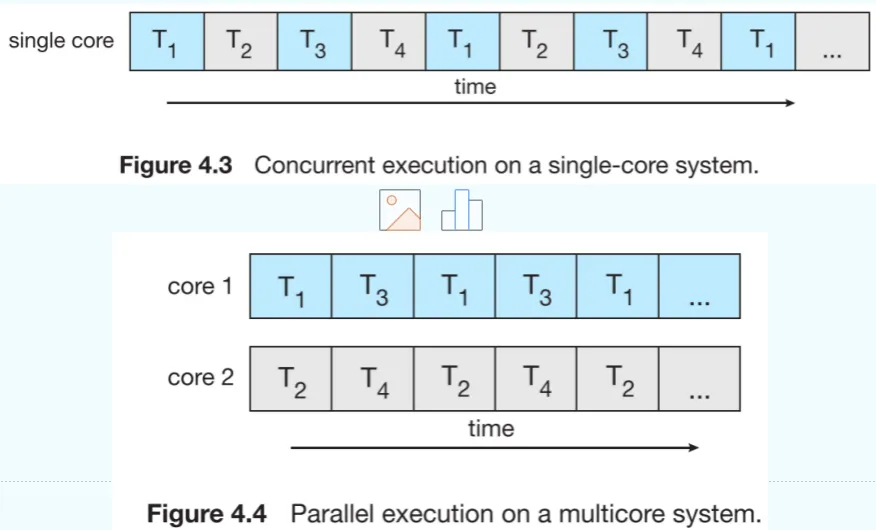
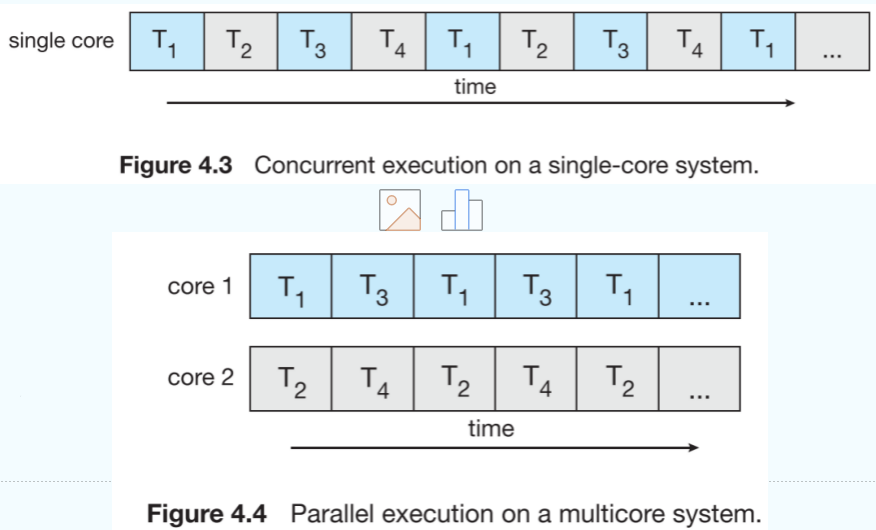
- 实际上,上面这张图也展示了==并发(Concurrency)与并行(Parallelism)==的区别:
- 并发 (Concurrency):指的是系统支持多个任务,并允许所有任务都能取得进展。在单核 CPU 系统上,这通过在多个任务(线程)之间快速切换来实现。虽然在任何给定的瞬间只有一个任务在运行,但从宏观上看,所有任务都在向前推进。
- 并行 (Parallelism):指的是同时执行多个任务。这意味着在同一时刻,有多个任务在不同的处理单元上真实地运行。
- 两者的区别就像上面的一样
当然,还是多线程还是有一点问题的,比如,多线程有可能会导致一个地址被同时访问,产生错误。
多核编程
无论是多个计算核在多个 CPU 芯片上,还是多个计算核在单个 CPU 芯片上,我们都称之为多核或者是多处理器系统。
并行和并发有所不同。并行指的是同时执行多个任务,而并发则是支持多个任务甚至是所有的任务都可以取得进展。并行一定是并发,并发不一定是并行。
编程挑战
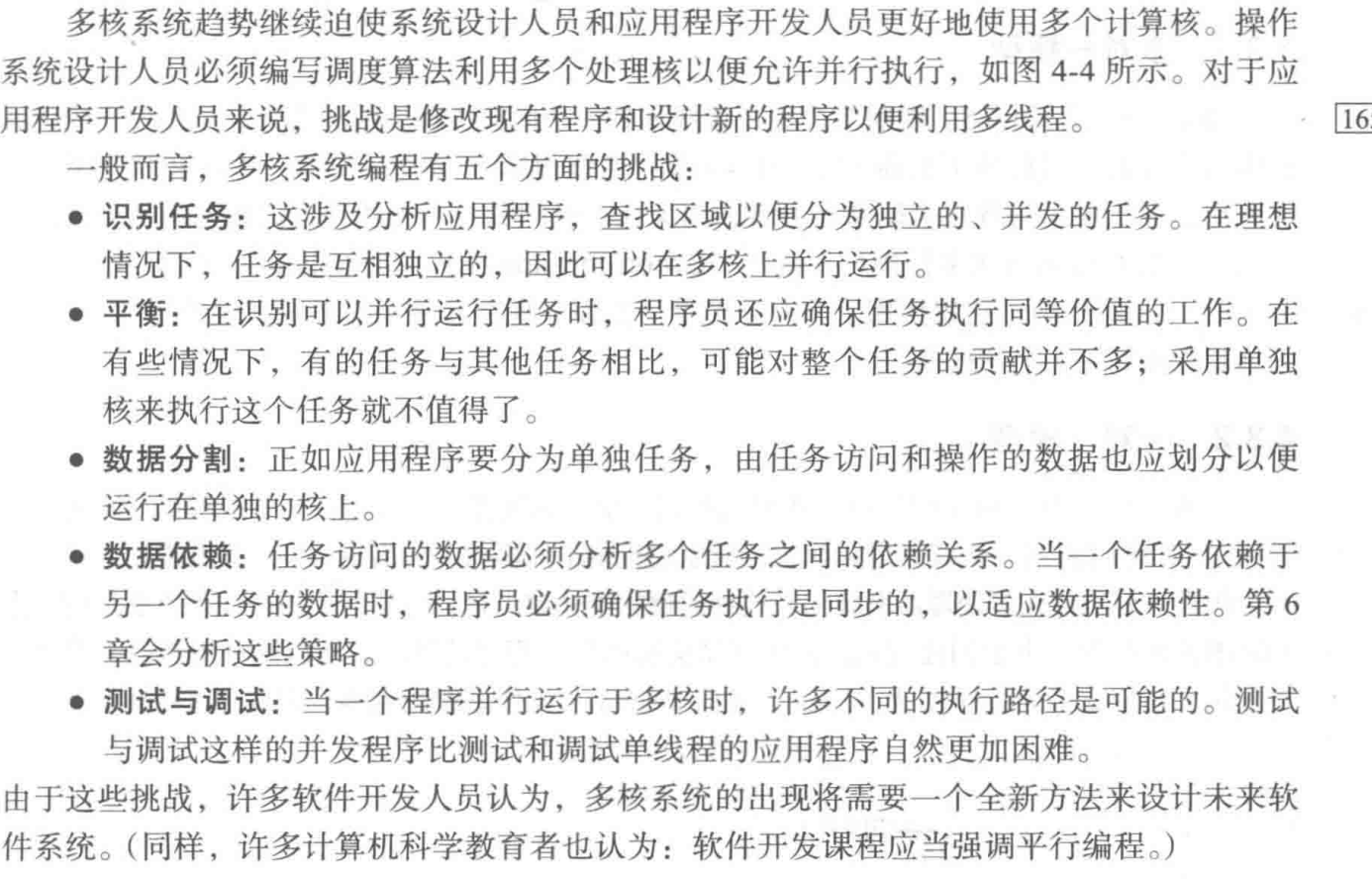
并行类型
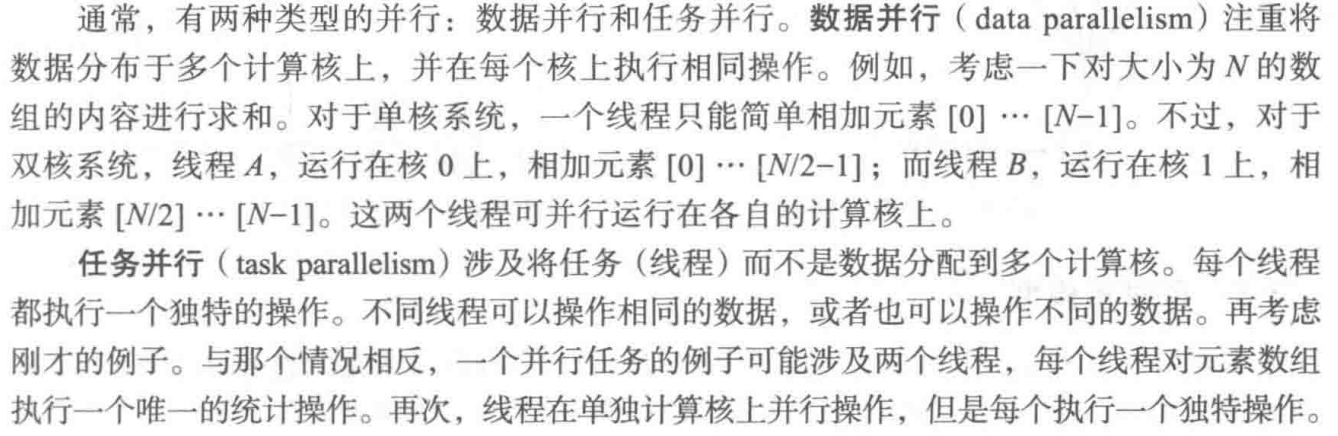

并行分为两种:
- 数据并行:数据分到不同的核上,任务操作相同
- 任务并行:不同任务分到不同核上
Multithreading Models
有两种不同方法来提供线程支持:User Threads 和 Kernal Threads,介绍分别如下:
- User Threads:
- Thread management done by user-level threads library
- Three primary thread libraries:
- POSIX Pthreads (can also be provided as system library)
- Win32 threads
- Java threads
- Kernal Threads:
- Supported by the Kernel
- Almost all contemporary OS implements kernel threads. Examples
- Windows XP/2000
- Solaris
- Linux
- MacOS
总结下如下:
| 比较维度 | 用户线程(User Threads) | 内核线程(Kernel Threads) |
|---|---|---|
| 管理者 | 由用户级线程库管理,如 Pthreads、Java Threads | 由操作系统内核直接管理 |
| 运行环境 | 用户态 | 内核态 |
| 创建/切换开销 | 小,线程切换不需要进入内核 | 大,线程切换涉及用户态与内核态转换 |
| 并发能力 | 受限,无法充分利用多核 CPU | 强,可在多核 CPU 上并行执行 |
| 阻塞影响 | 一个线程阻塞会导致整个进程阻塞 | 一个线程阻塞不会影响其他线程 |
| 可见性 | 操作系统不可见,只在进程内部可见 | 操作系统可见,可被调度器调度 |
| 调试难度 | 较高,操作系统无法直接跟踪 | 较低,系统工具可直接监控 |
| 适用场景 | 轻量级任务、需要快速切换的应用 | 多核并行、高性能计算、系统服务 |
| 示例系统支持 | Java虚拟机、某些轻量级线程库 | Windows XP/2000、Linux、Solaris、MacOS 等现代操作系统 |
用户线程和内核线程之间一定存在着某种关系,我们研究常用的建立这种关系的方法:Many-to-One、One-to-One、Many-to-Many。
Many-to-One
- Many user-level threads mapped to single kernel thread
- The scheduling is done completely by the thread library and the kernel itself is not aware of the multiple threads in user-space.
- Examples:
- Solaris Green Threads
- GNU Portable Threads
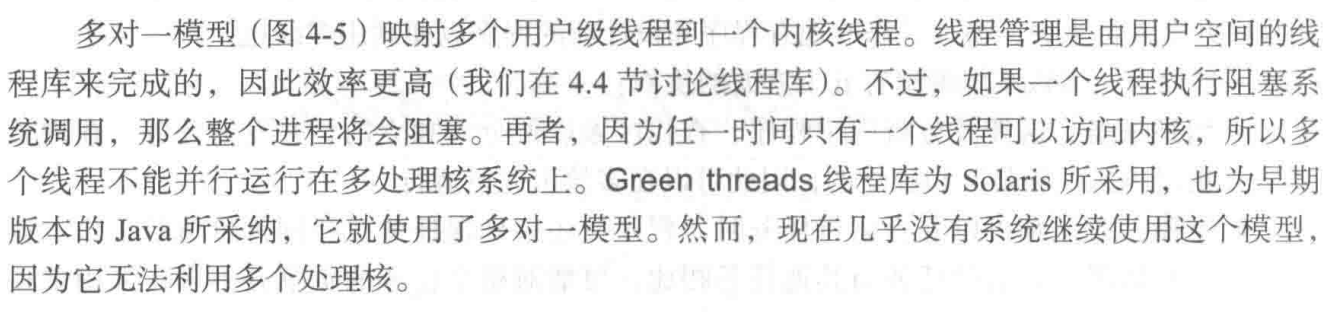
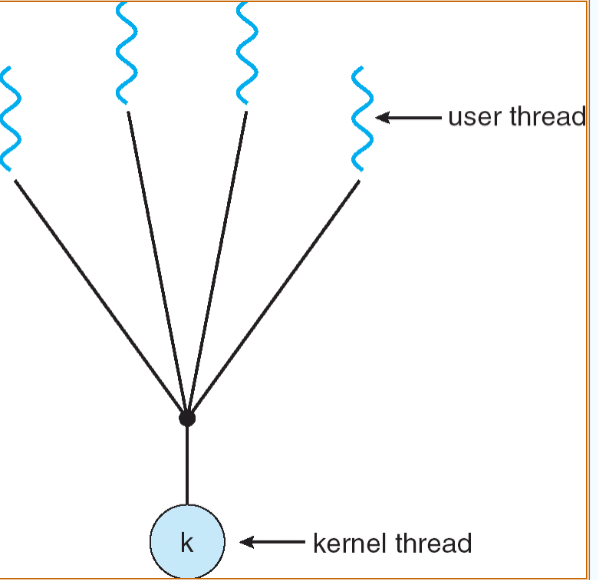
- 是多个用户级线程映射到一个内核线程上,内核并不知道用户层有多线程
One-to-One
- Each user-level thread maps to kernel thread
- Examples
- Windows NT/XP/2000
- Linux
- Solaris 9 and later

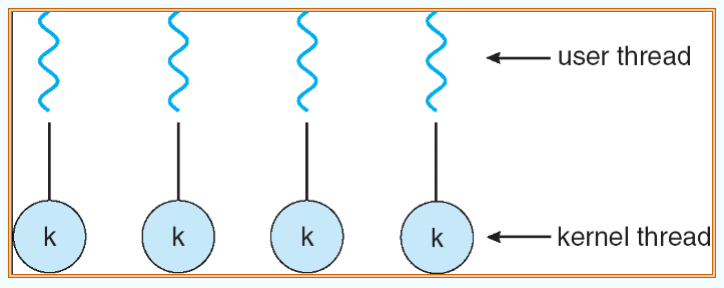
Many-to-Many Model
- Allows many user level threads to be mapped to many kernel threads
- Allows the operating system to create a sufficient number of kernel threads
- A program can have as many threads as are appropriate without making the process too heavy or burdensome. In this model, a user-level threads library provides sophisticated scheduling of user-level threads above kernel threads.
- Solaris prior to version 9
- Windows NT/2000 with the ThreadFiber package
- Go routines

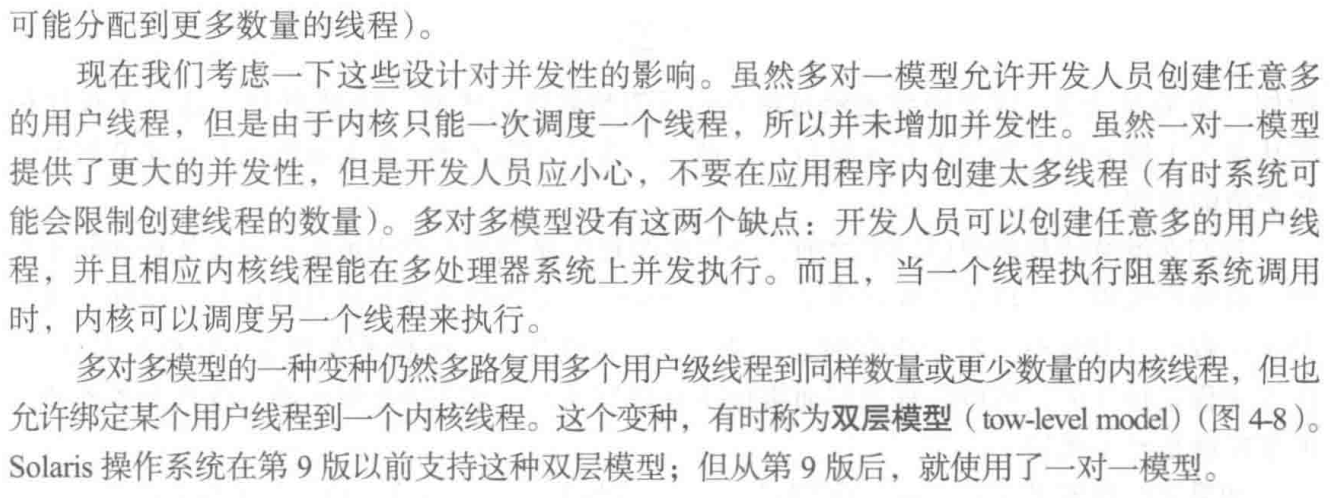
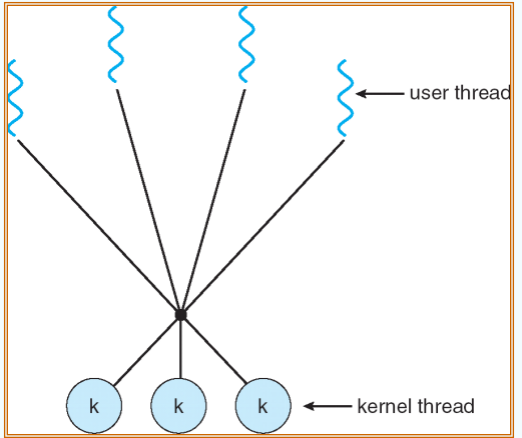
Two-level Model
- Similar to M
, except that it allows a user thread to be bound to a kernel thread - Examples
- IRIX
- HP-UXTru64
- UNIX
- Solaris 8 and earlier
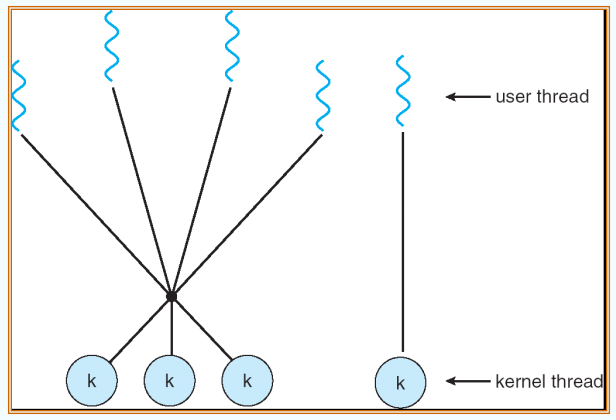
Threading Issuses
fork() and exec()
-
当某个进程调用 fork() 的时候,要么新进程复制所有的线程,要么仅仅复制了调用了系统调用 fork() 的线程。
-
但是,当 fork() 后面跟着 exec(),那么就不是这么一回事了。因为 exec() 参数指定的程序会取代整个进程(子进程的),在这种情况下,仅仅复制调用线程比较合适。
- 仅仅只复制调用了系统调用 fork() 的线程的话,exec()时只需要销毁一个线程;但要是新进程复制所有的线程,那就需要销毁掉所有的线程,再加载新进程,这种方式的开销过大。
-
不过,若是分叉后不调用 exec(),那么新进程还是应该重复所有的线程。
Thread Cancellation
- Terminating a thread before it has finished
- 线程撤销指的是在线程完成之前中止线程
- 我们称需要撤销的线程为目标线程(target thread)
- Two general approaches:
- Asynchronous cancellation terminates the target thread immediately
- Deferred cancellation allows the target thread to periodically check via a flag if it should be cancelled
- 延迟撤销。目标线程不断检查他是否应终止,这允许目标线程有机会有序终止自己。

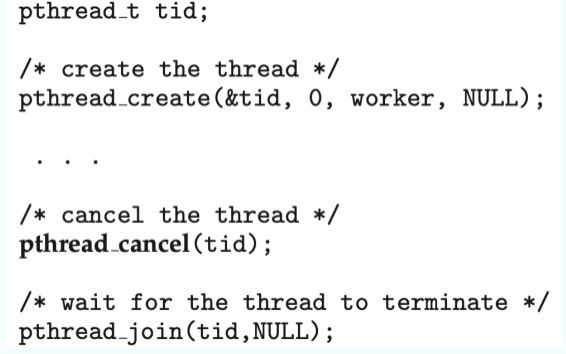
下方的pthread_join(tid, NULL)有点类似于之前讲过的wait操作。

Thread Pools
创建一个线程,需要一定的系统开销(比如 CPU 时间和内存)。若是对于所有的请求,如果我们都采用创建线程,运行结束后再销毁的方法,那么显而易见的,系统的开销回很大。
为了解决这样的问题,可以使用线程池。它的思想是在进程开始的时候就创建一定数量的线程,并加到池子里空转,等待工作。当需要的时候就取出来,运行完再放回去。
- Advantages:
- Usually slightly faster to service a request with an existing thread than create a new thread
- Allows the number of threads in the application(s) to be bound to the size of the pool
- 线程池限制了任何时候可用线程的数量。这对那些不能支持大量并发线程的系统非常重要